STEAM TURBINE TRAINING SET
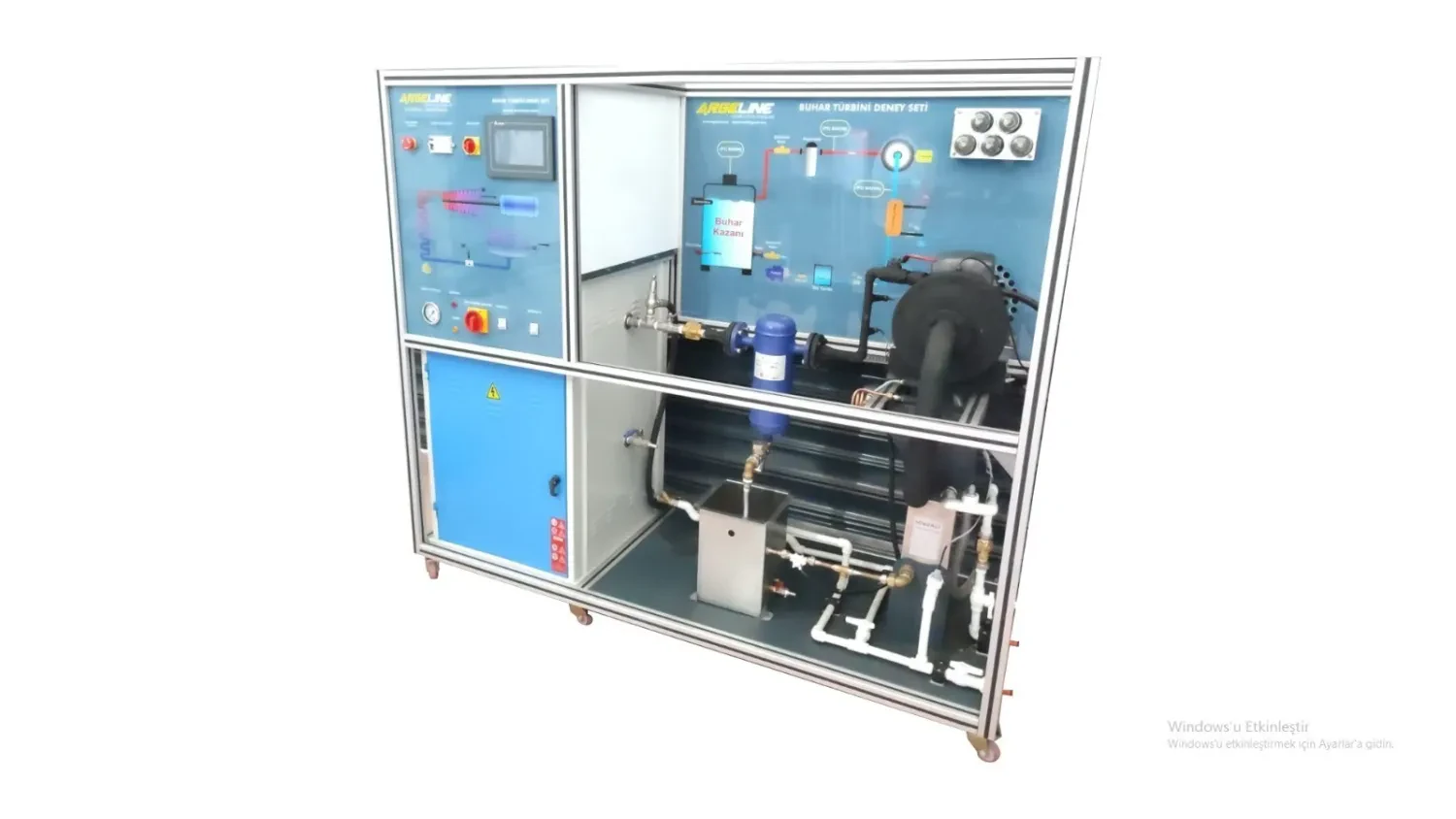
ÜRÜN GÖRSELLERİ
A system that converts the thermal energy of steam under high pressure into mechanical rotational energy. Typically, this results in electricity generation. Steam is directed to pass through installed blades at high speed, creating a rotational movement. Laval (convergent-divergent) nozzles are used to convert the pressure energy of the steam into energy most efficiently. These nozzles first narrow and then gradually widen. Due to the nozzle's shape, the steam pressure passing through is converted into kinetic energy, i.e., velocity. The higher the steam velocity, the greater the pressure exerted by the steam jet on the encountered obstacle. This also depends on the steam's initial trajectory. If the blades on a shaft redirect the incoming steam almost tangentially, the steam applies a force in the tangential direction that rotates the shaft.
To extract the energy in steam most efficiently, multi-stage turbines with successive stages are used. The blade sections of each stage are mounted on the same shaft and thus rotate at the same speed. This rotating assembly is called the rotor as a whole. Theoretically, all the steam pressure can be converted to velocity by reducing it to atmospheric pressure in a single nozzle. However, in this case, the shaft must rotate at very high speeds to achieve reasonable efficiency. This causes technical difficulties and may damage the machine due to large centrifugal forces. Turbines that use energy in successive stages are constructed based on various principles.
• Temperature measurement,
• Temperatures measured in the system can be read digitally,
• Measured temperatures can be taken with direct fluid contact,
• Temperature measurements can be performed with PT 100 probe,
• Digital data can be read on at least a 7’’ LCD screen,
• Pressures are measured digitally,
• All temperatures in the experimental device have fluid contact,
• Turbine speed can be digitally measured in the experimental device,
• Steam expansion angle in the device is 20 degrees,
• Maximum output power of the device is 1.2 KW,
• Turbine body temperature in the device is 50 degrees Celsius,
• Maximum steam pressure in the device is 5.5 bar,
• Three digital protection measures are implemented,
• The device contains 6 temperature sensors,
• The device includes 3 pressure transmitters,
• Plate heat exchanger is included in the device,
• Turbine speed ranges from min. 3000 to max. 30,000 rpm,
• At least one 10 kW steam generator is included alongside the device,
• A steam solenoid valve is included for safety to cut off the system in case of pressure or temperature increase,
• Data can be digitally measured and transferred to a computer.
• Experiment on calculating steam turbine efficiency,
• Experiment on calculating steam boiler efficiency,
• Experiment to determine condenser capacity and efficiency,
• Experiment investigating the relationship between turbine electrical power and rotational speed.