Heat Transfer
RADIATION HEAT TRANSFER CONDUCTION EXPERIMENT SET

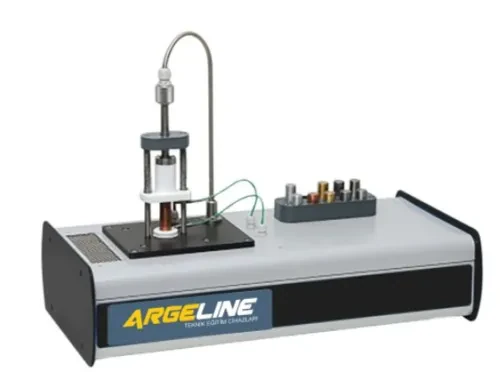
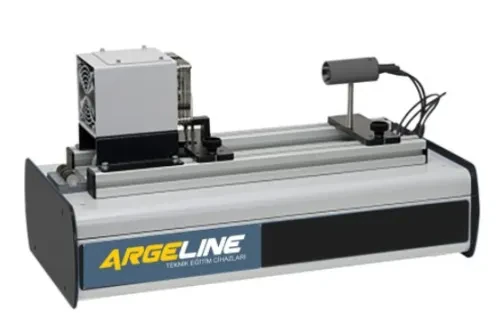
The radiation heat transfer training set covers heat radiation, one of the three fundamental forms of heat transfer. In radiation, heat transfer occurs through electromagnetic waves. Unlike heat conduction and convection, heat radiation can propagate even in a vacuum. Heat radiation does not depend on a material. This training set provides basic experiments aimed at targeted teaching. At the center of the experiment unit, there is a metallic sample heated by a concentrated light beam. The light beam is generated by a continuously adjustable halogen lamp and a parabolic reflector. The reflector focuses the radiation onto a focal point. A sample is placed on a thermocouple located at the focal point. The thermal radiation emitted by the sample is measured by a thermopile. To measure radiation at different distances, the thermopile is mounted on a movable carriage. Samples with different surface finishes can be selected. It allows testing with various samples.

metaLLERDE HEAT CONDUCTION EXPERIMENT SET

Heat conduction is one of the three fundamental modes of heat transfer. According to the second law of thermodynamics, heat always transfers from a higher energy level to a lower energy level. If the temperature of a body does not change despite continuous heat addition or removal, this is known as steady-state heat conduction. This training set is designed for conducting basic experiments on heat conduction through various metals. The upper part of the sample is heated with an electric heater, and the lower part is cooled with a Peltier element. Heat conduction occurs along the sample from top to bottom. Two samples can be placed simultaneously on the experimental unit to investigate thermal conductivity through multilayer metals. Perfectly compatible components ensure rapid heating and smooth measurements. The temperature of the metal samples is measured from the top and bottom via thermocouples.

MULTIPLE HEAT EXCHANGER EXPERIMENT SET

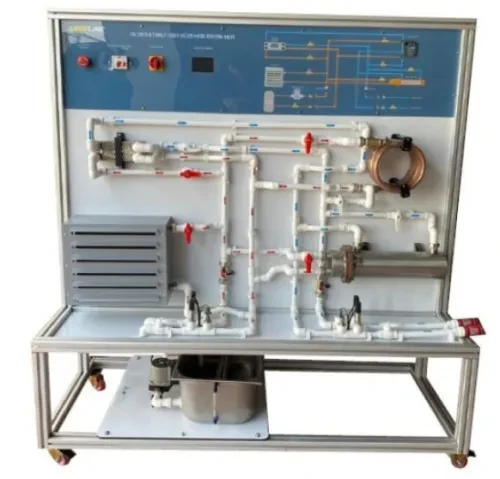
A heat exchanger is a general term given to heat transfer equipment that enables heat transfer between two fluids at different temperatures without mixing. The operating principle of different types of heat exchangers is fundamentally the same; the heat from the fluid at a higher temperature is first collected on the heat transfer surface (plate/tube), and then this heat is transferred to the other fluid at a lower temperature that is in contact with the other side of the same plate or tube. Thus, while one fluid gains heat and its temperature rises, the other loses heat and its temperature decreases. The experiment set allows observation of the functions and behaviors during the operation of heat exchangers, enabling the plotting of temperature curves, and the calculation of capacity and overall heat transfer coefficient in parallel flow and counterflow processes. 1. The device body will be made of aluminum profile and will be easily movable with wheels. 2. The device will include 4 different heat exchangers. 3. Changes at each heat exchange point will be monitored by heat sensors and thermometers. 4. The device will be manufactured to allow calculation of capacity and overall heat transfer coefficient according to different heat exchanger types. 5. A touch LCD screen will be available for tracking experiment data. 6. Additionally, it will be computer-controlled and have USB computer connection. 7. The device will be delivered with a case, and an experiment manual and circuit diagram will be provided. 8. It will be guaranteed by the seller for 5 years and service will be available for 10 years.

HEAT CONDUCTION IN LIQUIDS EXPERIMENT SET

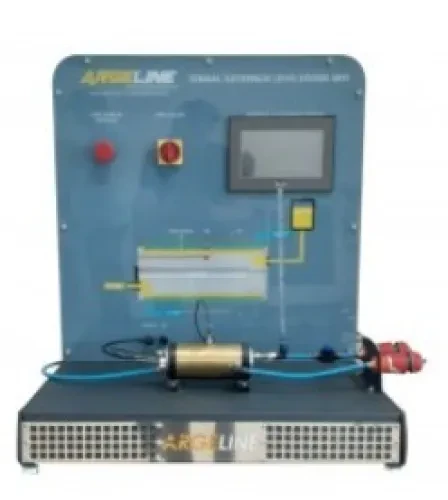
Heat conduction is one of the three fundamental modes of heat transfer. According to the second law of thermodynamics, heat always transfers from a higher energy level to a lower energy level. Two cylinders form the main components of the experimental unit; an electrically heated inner cylinder located inside a water-cooled outer cylinder. There is a concentric circular gap between the two cylinders. This ring-shaped gap is filled with the liquid under investigation. Heat conduction occurs from the inner cylinder through the liquid to the outer cylinder. The narrow ring-shaped gap prevents the formation of convective heat flow while allowing a relatively large transfer area and ensuring a homogeneous temperature distribution. The experimental unit is equipped with temperature sensors inside and outside the circular gap. Thermal conductivities can be tested for different fluids such as water, oil, air, or carbon dioxide.

HEAT (THERMAL) CONDUCTION EXPERIMENT SET

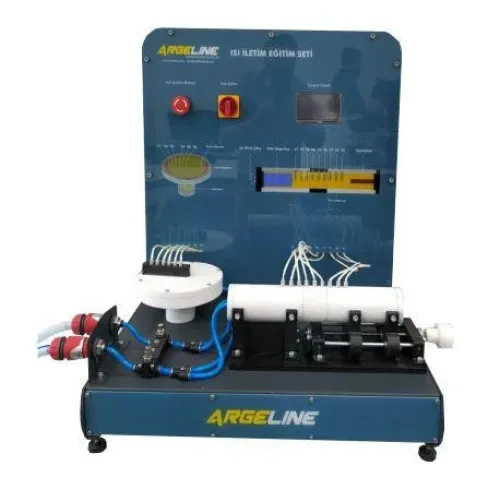
Our training set allows you to study linear and radial heat conduction in solids; temperatures are measured by sensors and read on a control unit. The objectives of our training set are; • Linear heat conduction (plane wall) (determination of temperature profiles for different materials, determination of temperature profile in case of deterioration, determination of thermal conductivity λ), • Radial heat conduction (determination of temperature profile, determination of thermal conductivity λ), • Insulation effect, • Determination of thermal contact resistance, • Effect of cross-sectional area, • Understanding the use of Fourier’s equation in determining the heat flux rate through solid materials.

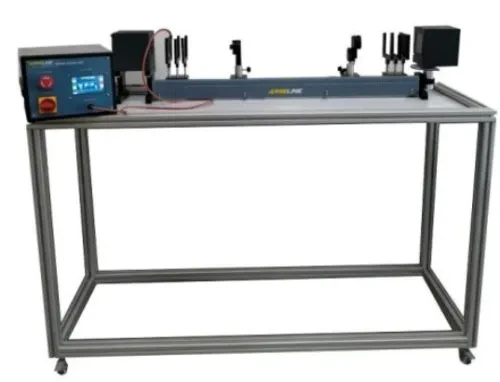
RADIATION RADIATION EXPERIMENT SET

The radiation radiation training set allows the investigation of radiant heat transfer and radiant heat exchange laws, fundamental laws of heat transfer by radiation (both heat and light). Two suitable detectors, light filters, target plates, and aperture plates are each mounted on appropriate carriers on a parallel graded path, enabling simple and fast experimental procedures. The electrically heated matte black radiant heat source is equipped with an integrated thermocouple for recording surface temperature. A radiometer directly detects heat flux in W/m² from a combination of four plates (two matte black, one gray, and one polished) or a holder formed by two movable mushroom-faced plates. Each plate with different emissivity contains a surface thermocouple for temperature measurement. The diffuse light source contains a low-voltage filament lamp housed in a rotatable enclosure (180°) that can be placed on the parallel path instead of the heat source. A light meter that records directly in lux can be placed instead of the radiometer to measure light intensity. Filter plates of various opacities and thicknesses can also be mounted on the rail to demonstrate light absorption laws.

NATURAL AND FORCED CONVECTION HEAT TRANSFER EXPERIMENT SET

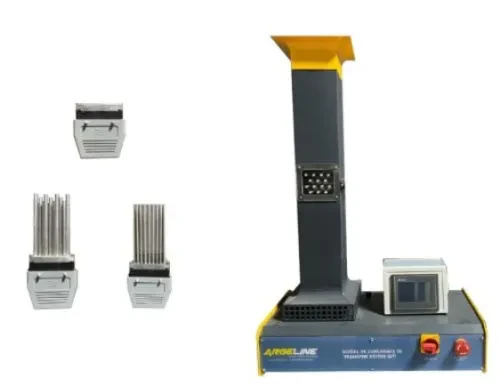
The natural and forced convection heat transfer experiment setup consists of a rectangular cross-section vertical channel, a power control unit, a fan installed inside the channel, various types of surfaces that can be placed inside the channel, temperature sensors, and a velocity meter. Thanks to the control unit, the thermal power supplied to the target surfaces can be adjusted. Similarly, the fan can be completely turned off or operated at different speeds to achieve various velocity values inside the channel. Additionally, surfaces with different geometries can be mounted inside the channel, and by applying thermal power to these surfaces, they can reach temperatures higher than the channel air. This temperature difference causes heat transfer by convection between the surface and the air. 1. The experiment set is designed to study the mechanism of heat transfer by natural and forced convection. 2. The device operates on 220 V AC power and includes an electrical grounding line in the experiment set. 3. The device includes flat plate type and finned type heaters. 4. Various types of heat exchangers are available, allowing experiments based on these heat exchangers. 5. A touch LCD screen is included for monitoring experiment data. 6. Additionally, it is computer-controlled and includes USB computer connectivity. 7. The device will be delivered with a casing, experiment manual, and circuit diagram. 8. It comes with a 5-year warranty from the seller and service availability for 10 years.
test ürün
test ürün

test